
about
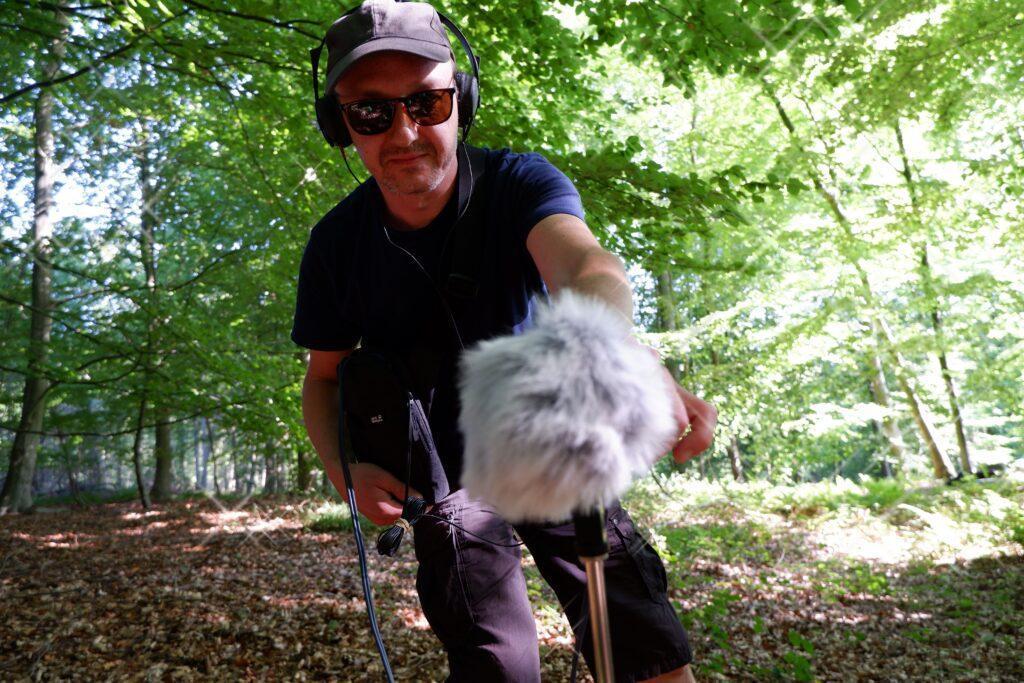
Roeland Luyten (born in Leuven, Belgium in 1977) is a composer of electroacoustic music. He first encountered electroacoustic sounds through watching science-fiction and horror movies as a young boy. At eight years old, he started studying flute at the music academy in Louvain. During high school, he taught himself to play the electric guitar and experimented with effects pedals. While studying classical flute at the Royal Conservatory of Antwerp, he discovered his true passion in the studio for electroacoustic music composition under the direction of Joris De Laet. Since then, Roeland regularly composes new pieces and works as a musician-composer, sound engineer, and stage technician for various theater and dance productions in Belgium and abroad. His music has been played and has won prizes worldwide.
Affiliations: Roeland Luyten is a member of the Belgian Federation for Electroacoustic Music (BeFEM), the Belgian section of the International Confederation for Electroacoustic Music (ICEM). He is closely associated with Musiques & Recherches (M&R), a Belgian association dedicated to the development of electroacoustic music and, more specifically, acousmatic music.
Electroacoustic music is a form of music that combines traditional acoustic sound with electronic technology to create immersive and often experimental sonic works. Rather than focusing primarily on melody or harmony, it emphasizes sound design, texture, space, and timbre, treating any sound—musical or non-musical—as potential compositional material.
This genre emerged in the mid-20th century alongside advances in recording and electronic technologies. Pioneers demonstrated that recorded sounds from everyday life, nature, or instruments could be transformed, manipulated, and organized into music. From this idea grew practices such as musique concrète, electronic music, and acousmatic music—a term rooted in the ancient Greek word ákousma, meaning “a thing heard.” Historically, it refers to the philosopher Pythagoras, who taught from behind a curtain so that his students would concentrate solely on his voice, rather than his physical presence. In contemporary acousmatic and electroacoustic music, this ancient principle translates to listening to sound purely through loudspeakers, divorced from any visible source, where sound independent of its origin is heard, encouraging deep and focused listening.
A defining element of electroacoustic music composition is sound design. Composers shape and transform recorded sounds, synthesized tones, and digitally generated material using tools such as sampling, filtering, spatialization, and digital signal processing. These techniques allow the creation of complex sonic environments that can evoke strong emotions, challenge perception, and transport listeners into imagined or abstract sound worlds.
Much electroacoustic music is created in the studio, which functions as a compositional instrument. The studio enables experimentation, layering, and precise control over sound, making it possible to construct detailed, three-dimensional listening experiences.
During the concert presentation of electroacoustic compositions, the spatial movement of sound—its precise journey around and between speakers—becomes a powerful expressive dimension. This spatialization can be approached in two primary ways: it can be composed into the fabric of the work itself in a fixed multichannel format (such as an octophonic piece), or it can be interpreted live by a performer. Using a multi-speaker orchestra known as an acousmonium, a performer diffuses sound in real time through manual gestures on a mixing console, dynamically sculpting its placement, motion, and depth. In this practice, spatialization is an integral part of the musical expression and a unique interpretation by the performer.
Overall, electroacoustic music is an exploratory and boundary-pushing art form. By blending composition, technology, and experimentation, it expands traditional ideas of what music can be and opens up new ways of listening to and understanding sound. What you hear is what you get.
- 2024: Second prize in the XVI Acousmatic Music Composition Competition Destellos 2024 of the Foundation Destellos (Argentina) for the work “Gritscape“.
- 2023: Selected on MA/IN 2023, international electroacoustic music festival Matera Intermedia in Matera, Italy for the work “Gritscape”.
- 2018: First prize & Public prize (ex aequo) in the “10th biennial acousmatic composition competition Métamorphoses 2018” of Musiques & Recherches (Belgium) with the composition “Knars”
- 2017: Jury member for the “10th International Competition of Electroacoustic Music Composition of The Foundation Destellos” (Argentina).
- 2017: Selected on BEAST FEaST 2017, the international electroacoustic music festival in Birmingham, United Kingdom for the piece “Helena”.
- 2016: Selected on MA/IN 2016, international electroacoustic music festival Matera Intermedia in Matera, Italy for the work “Helena”.
- 2014: First prize in the “7th International Competition of Electroacoustic Music Composition, Category Acousmatic, of The Foundation Destellos” (Argentina) for the work “Helena“.
- 2014: Finalist at the “Electro-acoustic music” section of the international composition competition “Città di Udine” – Tenth Edition (2014) – TEM, (Italy) for the composition “Helena“.
- 2014: Special mention at the “8th Biennial Acousmatic Composition Competition Métamorphoses 2014” of Musiques & Recherches for the piece “Helena“.
- 2012: Nominated in the “5th International Competition of Electroacoustic Composition and Visual-music” of the Foundation Destellos in Buenos Aires, Argentinië for his work “INERT”.
- 2010: Finalist at the “8th International Competition for Composers “Città di Udine” – Tenth Edition (2014) – TEM” in Italy for the work “Hooks”.
- 2010: Special mention at the “6th Biennial Acousmatic Composition Competition Métamorphoses 2014” of Musiques & Recherches for the piece “Hooks”.
- 2005: Third prize at the “5th International Computer Music Competition, Pierre Schaeffer 2005” in Italy for the piece “Decyclage”.
- 2005: Composition commission by the Flemish Community provided by Logos Foundation in Ghent.
- 2004: Nomination in the category of multimedia on the “31ème Concours International de Musique et d’Art Sonore Electroacoustique” at Bourges (France) for the music of the dance performance “roest”, a production of VZW Kwaadbloed.
